
Keywords
political speech analysis
symbolic interaccionism
educational reform
Categories
How to Cite
Abstract
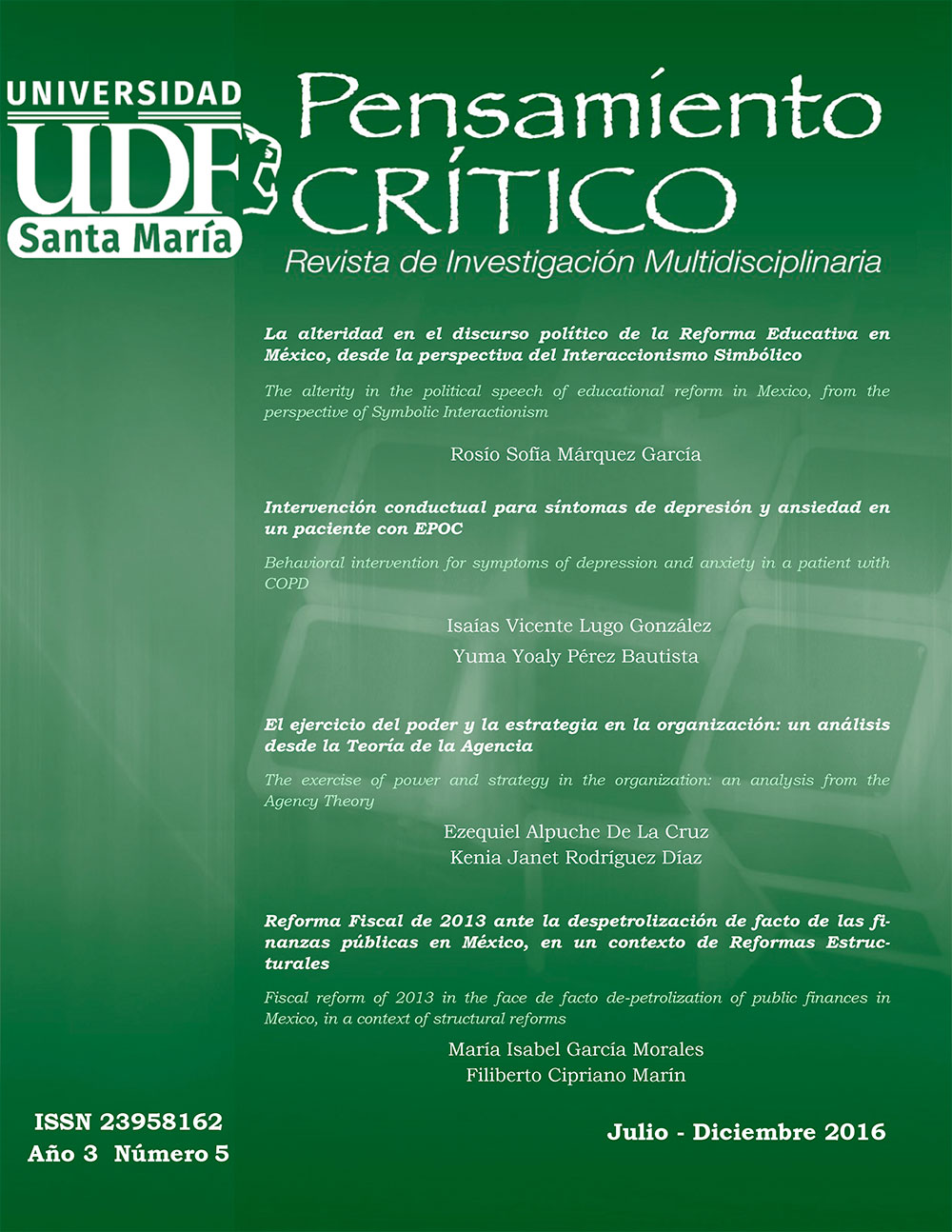
The article in this text shows the results of the analysis of the political speech regarding the Educational Reform from a symbolic interaccionism perspective, to explain the Otherness significances contained, the analysis material is the speech emitted by the President Enrique Peña Nieto in the promulgation act of the Educational Reform. For the purposes of the present investigation, the postulates of the Symbolic Interaccionism were used; given that this new paradigm of the speech analysis enables the interpretation of the significances of human interactions, from the social structure, as the principal political event. Being the analyzed text a political speech constructed from the an identity-based institutional center, its social interpretation is legit, far from an inclusive educational politic which enables the participation of every actor; so, it does not consider otherness.
References
Aires, L. T. (2006). Alteridad y emociones en las comunidaes virtuales de aprendizaje. Teoría de la Educación. Educación y Cultura en la Sociedad de la Información, 7 (2), 75-81.
Álvarez-Gayou, J. L. (2014). Cómo hacer investigación cualitativa. Fundamentos y metodología. México, D.F.: Paidós Educador.
Blumer, H. (1969). Symbolic interactionism. Perspective and method. Englewood Cliffs, NJ: Prentice-Hall, Inc.
Cáceres , G. (2005). Sociología y comunicología. Argentina: Eucasa.
Fowler, R. (1996). On critical linguistics. En C. R. Caldas-Coulthard, & M. Coulthard (Eds.). Text and Practices. Readingsin critical discourse analysis, pp. 3-13. Great Britain: Routledge.
Gómez, G. J. (2015). Sarte. España: RBA Contenidos Editoriales y Audiovisuales, S.A.U.
Joas, H. (2004). Interaccionismo Simbólico. En A. T. Giddens , & J. Turner (Edits.), La teoría social hoy, pp. 112-154. Madrid, España: alianza.
Mead, G. H. (1938). The philosophy of the act. Chicago: University of Chicago Press.
Mendoza, A. J. (2014). El legado de George H. Mead. En V. H. Cardoso, Microsociología e Interaccionismo Simbólico, pp. 99-128). México: UNAM FESA.
Miranda, R. R. (2010). La noción de alteridad en Cornelius Castoriadis. Tesis doctoral. Madrid: Universidad Complutense.
OCDE. (2015). Programa para la evaluación internacional de alumnos (PISA) 2015. Obtenido de https://www.oecd.org/pisa/PISA-2015-Mexico-ESP.pdf
Parra, M. (2011). La hipótesis de Sapir-Whorf. Forma y función, 3, 9-16.
Presidencia de la Republica (25 de febrero de 2013) Promulgación de la Reforma Constitucional en Materia Educativa [discurso de presidencial de Enrique Peña Nieto]. Recuperado de: https://www.gob.mx/presidencia/prensa/promulgacion-de-la-reforma-constitucional-en-materia-educativa?idiom=es
Ruiz, C. (2009). La alteridad. Casa del Tiempo, 25 (4), 99-101.
Soler Mas, Y., & Badía Valdés, A. T. (2015). Bases teórico-metodológicas para el análisis crítico del discurso periodístico impreso en periodos de campañas políticas. Su aplicación al estudio de la prensa venezolana. Razón y Palabra, 92, 1-34.
Stocker, G (1997). Public-Private Partnerships and Urban Gorvernance. London: Macmillan.
Van Dijk, T. A., & Mendizabal, I. R. (1999). Análisis del discurso político y social. Quito, Ecuador: ABYA-YALA.

This work is licensed under a Creative Commons Attribution-NonCommercial-NoDerivatives 4.0 International License.
Copyright (c) 2025 Pensamiento Crítico. Revista de Investigación Multidisciplinaria