Keywords
Deaf
Condom
Sexually transmitted infections
Categories
How to Cite
Abstract
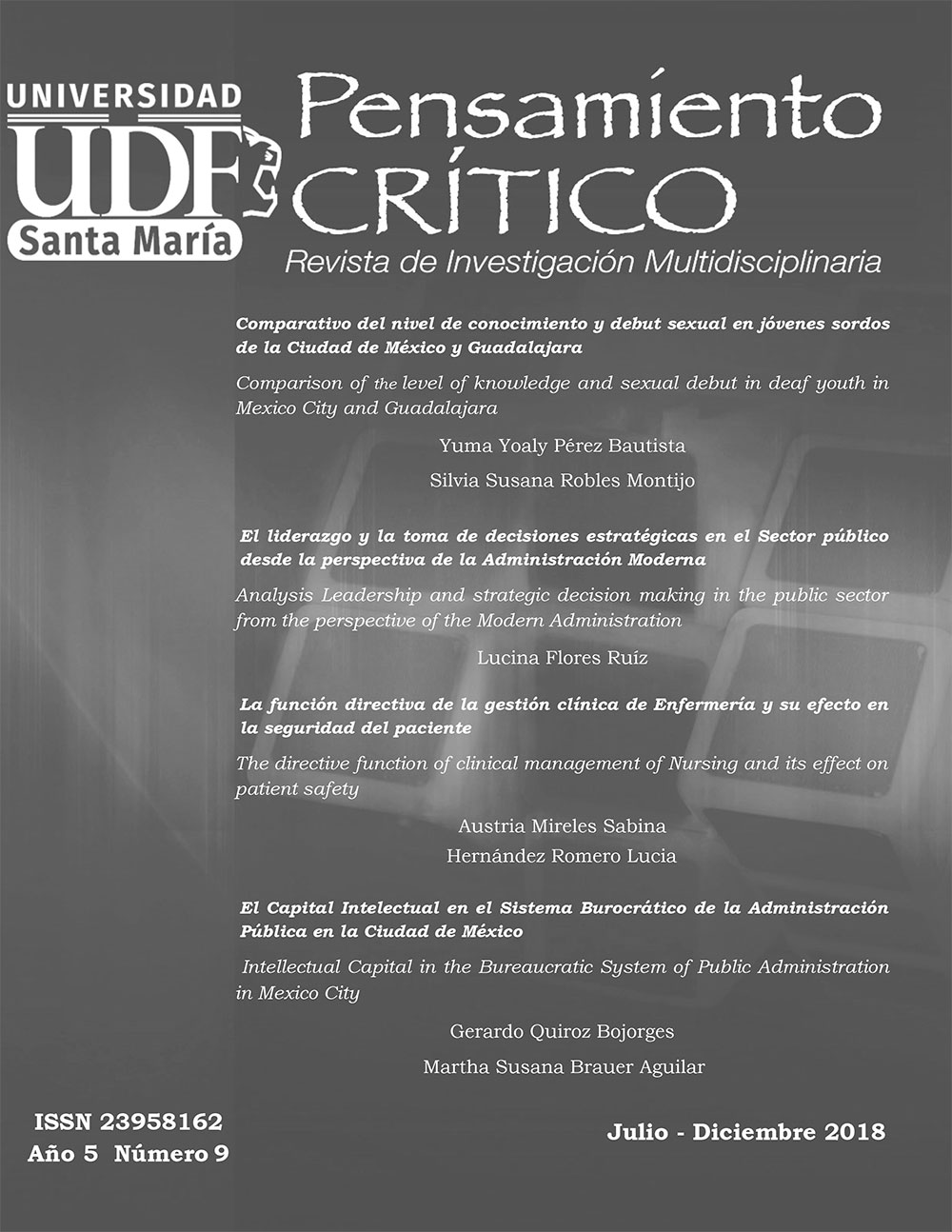
Educational institutions have played an important role in the sexual education of young people, however, these can be regulated by public policies and the population, an example of this is the population with disabilities. Therefore, the objective of the present study was to know and compare in deaf youth of educational institutions located in two geographical areas of the country, the level of knowledge they have about the use of condoms and about STIs, and their relationship with the first sexual encounter. It was found that most of the youth of a high school in the City of Guadalajara did not yet begin their sexual life and that their level of knowledge about condom use was higher, compared to the youth of an institution located in the City of Mexico. Although no association was found between sexual debut and the level of knowledge, the data of the present study are discussed by based on the importance of educational institutions in the field of sexual health and the design of programs for this population.
References
Anderson, P., & Kitchin, R. (2000). Disability, space and sexuality: access to family planning services. Social Science & Medicine, 51(8), 1163-1173. doi:10.1016/S0277-9536(00)00019-8
Espada, J. P., Morales, A., & Orgilés, M. (2014). Riesgo sexual en adolescentes según la edad de debut sexual. Acta Colombiana de Psicología, 17(1), 53-60. doi: 10.14718/ACP.2014.17.1.6
Fisher, J., & Fisher, W. (1992). Changing AIDS-risk behavior. Psychological Bulletin, 3(3), 455-474. doi:10.1037/0033-2909.111.3.455
Goldstein, M. F., Eckhardt, E. A., Joyner-Creamer, P., Berry, R., Paradise, H., & Cleland, C. M. (2010). What do deaf high school students know about HIV? AIDS Education and Prevention, 22(6), 523-537. doi.10.1521/aeap.2010.22.6.523
González, E., Molina, T., & Luttges, C. (2015). Características de la educación sexual escolar recibida y su asociación con la edad de inicio sexual y uso de anticonceptivos en adolescentes chilenas sexualmente activas. Revista chilena de obstetricia y ginecología, 80(1), 24-32. doi: 10.4067/S0717-75262015000100004
Groce, N., Yousafzai, A & Van Der, F. (2007). HIV/ADIS and disability: Differences in HIV/ADIS knowledge between deaf and hearing people in Nigeria. Disability and Rehabilitation, 29 (5), 367-371. doi:10.1080/09638280600834567
Guevara, Y., Ortega, P., & Plancarte, P. (2001). Psicología conductual. Avances en educación especial. Facultad de Estudios Superiores Iztacala. Universidad Nacional Autónoma de México.
Hanass-Hancock, J., & Satande, L. (2010). Deafness and HIV/AIDS: a systematic review of the literature. African Journal of AIDS Research, 9(2), 187-192. doi:10.2989/16085906.2010.517488
Job, J. (2004). Factors involved in the ineffective dissemination of sexuality information to individuals who are deaf or hard of hearing. American Annals of the Deaf, 149(3), 264-273. doi:10.1353/aad.2004.0025
Lee, Y., Cintron, A., & Kocher, S. (2014). Factors related to risky sexual behaviors and effective STI/HIV and pregnancy intervention programs for African American adolescents. Public Health Nursing, 31(5), 414-427. doi:10.1111/phn.12128
Mall, S., & Swartz, L. (2014). Attitudes toward condom education amongst educators for Deaf and hard-of-hearing adolescents in South Africa. African Journal of Primary Health Care & Family Medicine, 6(1), 1-4. doi:10.4102/phcfm.v6i1.564
Mendoza, L., Claros, D. I., & Peñaranda, C. (2016). Actividad sexual temprana y embarazo en la adolescencia: estado del arte. Revista chilena de obstetricia y ginecología, 81(3), 243-253.
Miller, T. (1999). Social/sex education for children and youth who are deafblind. En: J. McInnes (Ed.), A guide to planning and support for Individuals who are deafblind (pp. 201-226). Canada: University of Toronto.
Moinester, M., Gulley, S., & Watson, S. (2008). The nature of risk: HIV/ADIS and the deaf community in the United States. Disability Studies Quarterly, 28 (4).
Muñoz-Baell, I., Ruiz-Cantero, M., Álvarez-Dardet, C., Ferreiro-Lago, E., & Aroca-Fernández, E. (2011). Comunidades sordas: ¿pacientes o ciudadanas? Gaceta Sanitaria, 25(1), 72-78. doi:10.1016/j.gaceta.2010.09.020
Robles, S., Guevara, Y., Moreno, D., Frías, B., Rodríguez, M., & Bárcena, S. (2015). Factores relacionados con embarazo no deseado y abuso sexual en jóvenes mexicanos con discapacidad auditiva: evaluación e intervención (Informe técnico núm. 1). PAPIIT/DGAPA/UNAM.
Shackleton, J. (2009). Exploring perceptions of deaf persons for recommendations towards effective HIV/ADIS Programming in Nairobi. Journal of Human Development, Disability, and Social Change, 18(2), 59-76.

This work is licensed under a Creative Commons Attribution-NonCommercial-NoDerivatives 4.0 International License.
Copyright (c) 2025 Pensamiento Crítico. Revista de Investigación Multidisciplinaria