
Keywords
verification procedure
tax obligation
taxpayer rights
Categories
How to Cite
Abstract
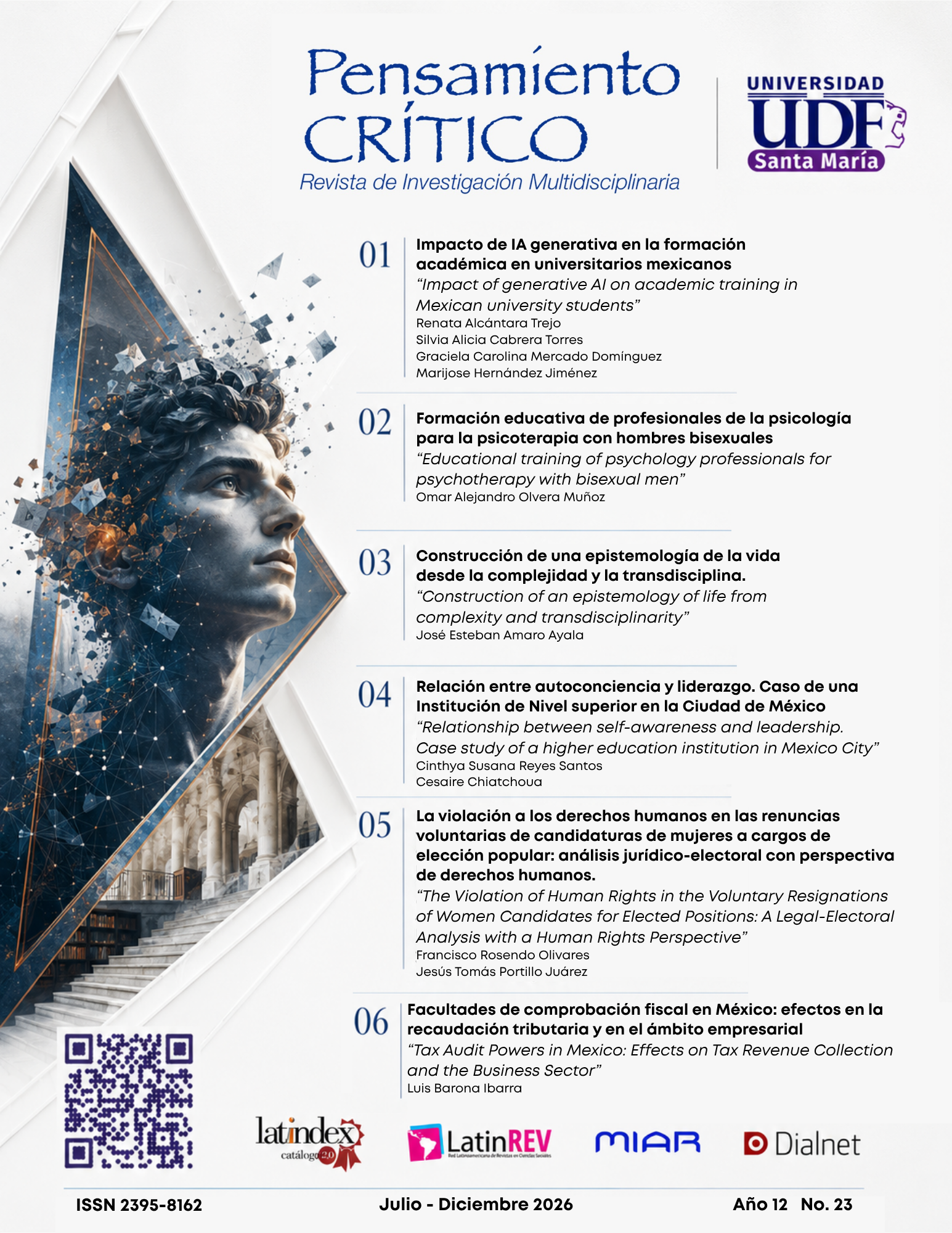
This article presents research based on a practical case involving a company that qualifies as a taxpayer, whose business activity is the construction of family housing, and which was reviewed by the Tax Administration Service (SAT) for compliance with its tax obligations. The study analyzes the SAT’s audit powers, the authority of its officials to issue actions such as freezing the taxpayer’s bank accounts, the overreach of such powers, the consequences of failing to provide accounting information, the taxpayer’s right to request the unfreezing of accounts, the amparo lawsuit as a means of legal defense, in the taxpayer, the collection of contributions, and an overview of the new Amparo Law.
References
Coto, D. (2020, 13 de octubre). Jefa del SAT reconoce riesgo de abuso en visitas domiciliarias videograbadas. El Contribuyente. https://www.elcontribuyente.mx/2020/10/jefa-del-sat-reconoce-riesgo-de-abuso-en-visitas-domiciliarias-videograbadas/
Gobernación, Secretaría de. (2025, 15 de septiembre). Iniciativa de reformas a la Ley de Amparo. Secretaría de Gobernación. https://infosen.senado.gob.mx/sgsp/gaceta/66/2/2025-09-15-1/assets/documentos/EJ_Ini_Ley_Amparo.pdf
Gobierno de México. (2025). Plan Nacional de Desarrollo 2025–2030. https://www.gob.mx/cms/uploads/attachment/file/981072/PND_2025-2030_v250226_14.pdf
Mayer-Serra, C. (2009). La industria del amparo fiscal. Política y Gobierno, 16(2), 349–383. https://www.scielo.org.mx/scielo.php?script=sci_arttext&pid=S1665-20372009000200004
Mora, S. (2025, 26 de junio). Poder Judicial ha resuelto en favor de la autoridad 49% de los juicios fiscales desde 2019. El Economista. https://www.eleconomista.com.mx/economia/judicial-resuelto-favor-autoridad-49-juicios-fiscales-20250626-765376.html
Patiño, D. (2026, 16 de febrero). El SAT gana más juicios fiscales gracias a la SCJN. Expansión. https://expansion.mx/economia/2026/02/16/sat-gana-mas-juicios-fiscales-gracias-scjn
PRODECON. (2025). Análisis sistémicos, enlace y regulación. Procuraduría de la Defensa del Contribuyente.https://www.prodecon.gob.mx/home-prodecon/analisis-sistemicos-enlace-y-regulacion/
Saldaña, I. (2025, 20 de octubre). Corte aplica primer criterio por reforma a Ley de Amparo: ministros y magistrados no pueden ser impedidos en juicios. La Jornada. https://www.jornada.com.mx/noticia/2025/10/20/politica/corte-aplica-primer-criterio-por-reforma-a-ley-de-amparo-ministros-y-magistrados-no-pueden-ser-impedidos-enjuicios
Saldívar, B. (2023, 25 de mayo). SAT ganó 47% de los juicios fiscales vs. contribuyentes. El Economista. https://www.eleconomista.com.mx/sectorfinanciero/SAT-gano-47-de-los-juicios-fiscales-vs.-contribuyentes-20230525-0063.html
Secretaría de Hacienda y Crédito Público. (2025). Informe tributario y de gestión al cuarto trimestre 2024. https://omawww.sat.gob.mx/cifras_sat/Documents/ITG_2024_4T.pdf
Vergara, S. (2017). Procedimientos de fiscalización: ¿un derecho fiscal de la sospecha? Paideia MX.

This work is licensed under a Creative Commons Attribution-NonCommercial-NoDerivatives 4.0 International License.
Copyright (c) 2026 Pensamiento Crítico. Revista de Investigación Multidisciplinaria