

Keywords
Workplace
Emotional identity
Functional numbness
Affective regulation
Categories
How to Cite
Abstract
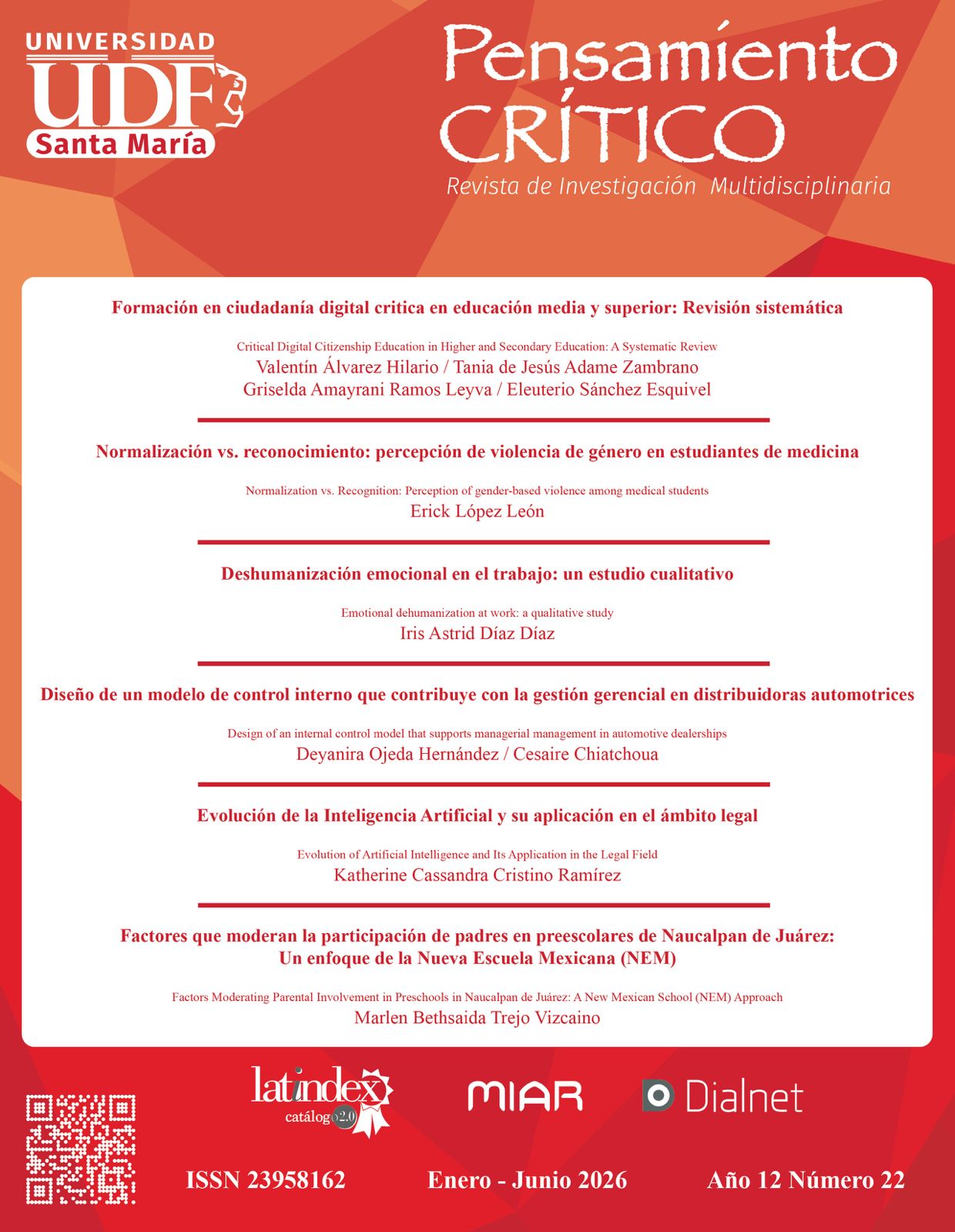
The study analyzes emotional dehumanization at work as an organizational process that shapes employees’ affective identity, leading to forms of functional numbness. A qualitative descriptive–interpretative design was used, drawing on semi-structured interviews with 18 workers from a clinical organization in Mexico City, analyzed through thematic analysis. Findings identify three central processes: emotion conceived as a performance instrument, empathic “switching off” as an adaptive strategy to work pressure, and functional numbness as the normalization of emotional distress. These dynamics manifest in constant affective regulation, emotional suppression, and the acceptance of exhaustion as a routine condition of work. Emotional dehumanization is understood as an organizational phenomenon sustained by affect-regulation systems and performance-oriented cultures. Reversing this dynamic requires structural transformations and humanistic management models that acknowledge emotionality as a constitutive dimension of work and organizational well-being.
References
Ashforth, B. E., & Humphrey, R. H. (1995). Emotion in the workplace: A reappraisal. Human Relations, 48(2), 97–125. https://doi.org/10.1177/001872679504800201
Bauman, Z. (2007). Vida de consumo. Fondo de Cultura Económica.
Bauman, Z. (2017). Modernidad líquida. Fondo de Cultura Económica.
Bourdieu, P. (1997). Razones prácticas: Sobre la teoría de la acción. Anagrama.
Braun, V., & Clarke, V. (2006). Using thematic analysis in psychology. Qualitative Research in Psychology, 3(2), 77–101. https://doi.org/10.1191/1478088706qp063oa
Castells, M. (2017). Ruptura: La crisis de la democracia liberal. Alianza Editorial.
Cortina, A. (2010). Ética de la empresa: Claves para una nueva cultura empresarial. Trotta.
Dejours, C. (2009). Trabajo y sufrimiento. Topía.
Etzioni, A. (1975). Organizaciones modernas. UTEHA.
Fineman, S. (2004). Entender las emociones en las organizaciones. Thomson.
Foucault, M. (2000). Vigilar y castigar: Nacimiento de la prisión. Siglo XXI Editores.
Goffman, E. (2001). La presentación de la persona en la vida cotidiana. Amorrortu.
Goleman, D. (2018). La inteligencia emocional en la empresa. Kairós.
Grandey, A. A. (2000). Emotion regulation in the workplace: A new way to conceptualize emotional labor. Journal of Occupational Health Psychology, 5(1), 95–110. https://doi.org/10.1037/1076-8998.5.1.95
Gross, J. J. (1998). The emerging field of emotion regulation: An integrative review. Review of General Psychology, 2(3), 271–299. https://doi.org/10.1037/1089-2680.2.3.271
Han, B.-C. (2012). La sociedad del cansancio. Herder.
Han, B.-C. (2021). La sociedad del cansancio (Ed. ampliada). Herder.
Haslam, N. (2006). La deshumanización. Revista de Psicología Social, 21(3), 231–239.
Haslam, N. (2006). Dehumanization: An integrative review. Personality and Social Psychology Review, 10(3), 252–264. https://doi.org/10.1207/s15327957pspr1003_4
Hochschild, A. R. (1983). The managed heart: Commercialization of human feeling. University of California Press.
Hochschild, A. R. (2015). La mercantilización de la vida íntima. Katz.
Hochschild, A. R. (2015). La gestión emocional: La comercialización de los sentimientos. Herder.
Illouz, E. (2007). Intimidades congeladas: Las emociones en el capitalismo. Katz.
Kunda, G. (1992). Engineering culture: Control and commitment in a high-tech corporation. Temple University Press.
Lincoln, Y. S., & Guba, E. G. (1985). Naturalistic inquiry. SAGE.
Marx, K. (2000). El capital: Crítica de la economía política. Tomo I. Siglo XXI Editores.
Maslach, C., & Jackson, S. E. (1981). The measurement of experienced burnout. Journal of Occupational Behaviour, 2(2), 99–113. https://doi.org/10.1002/job.4030020205
Maslach, C., & Leiter, M. P. (2016). La experiencia del burnout: Cómo reconocerlo y superarlo. Paidós.
Mead, G. H. (2009). Espíritu, persona y sociedad. Anagrama
Nussbaum, M. C. (2016). Las emociones políticas: ¿Por qué el amor es importante para la justicia? Paidós.
Sennett, R. (2006). La cultura del nuevo capitalismo. Anagrama.
Sennett, R. (2019). La corrosión del carácter. Anagrama.
Van Manen, M. (1990). Researching lived experience: Human science for an action sensitive pedagogy. SUNY Press.

This work is licensed under a Creative Commons Attribution-NonCommercial-NoDerivatives 4.0 International License.
Copyright (c) 2026 Pensamiento Crítico. Revista de Investigación Multidisciplinaria